Breaker trips when it rains: Safe next steps
Quick answer
A breaker that repeatedly trips during or after rain usually points to moisture exposure or a ground-fault path somewhere on the protected circuit. Treat the trip as protection: keep a wet or repeatedly tripping circuit off, stay away from wet electrical equipment, and arrange inspection by a licensed electrician.
Common questions
- Why does my breaker trip only when it rains?
- Rain can reach a damaged cover, exterior box, light, cord, pump, feeder, or other part of the circuit and create leakage or a fault path. The weather pattern is useful evidence, but it does not identify the exact wet component.
- Can I reset the breaker after the rain stops?
- Do not reset a circuit that is wet, has tripped repeatedly, or shows damage, heat, odor, noise, arcing, or an immediate retrip. Dry-weather recovery does not prove the fault is repaired; arrange qualified inspection.
- Does rain tripping mean the breaker is bad?
- Not by itself. A breaker may be correctly responding to a fault elsewhere on the circuit. The breaker, connected equipment, wiring, enclosures, and protection type all need to be evaluated before replacement is recommended.
- What should I tell the electrician?
- Share the breaker label and visible type, everything that lost power, the delay between rain and the trip, wind direction or sprinkler use, dry-weather behavior, recent work, and any safely observed water or exterior damage.
Source note: Reviewed November 16, 2026 against current Schneider Electric GFCI and moisture guidance and U.S. Consumer Product Safety Commission outdoor electrical and GFCI guidance. Breaker indications and test procedures are model-specific; the exact manufacturer instructions and local electrical rules control.
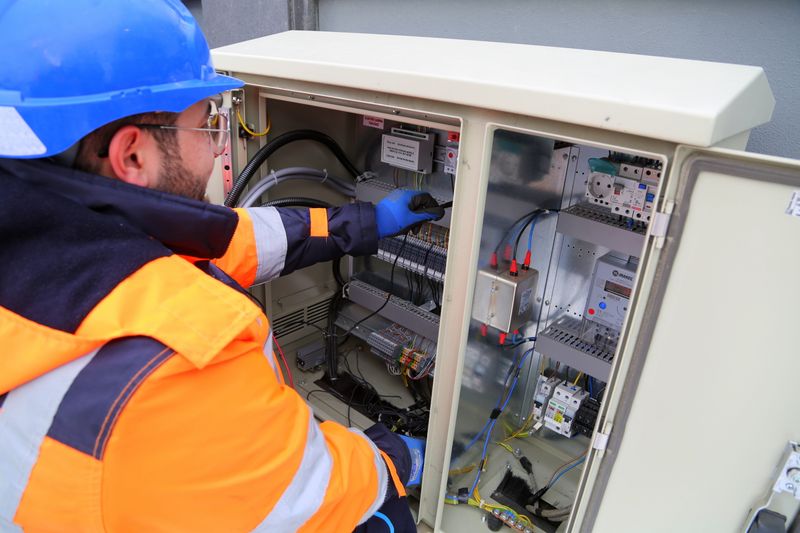
If a breaker trips when it rains, assume moisture or a ground-fault path may be affecting the protected circuit. Keep a wet or repeatedly tripping circuit off, do not keep resetting it to see whether it holds, and arrange inspection by a licensed electrician.
The rain connection is a clue, not a remote diagnosis. Water may be reaching an outdoor receptacle, light, cord, pump, junction box, garage or shed circuit, underground feeder, damaged cable, or building leak. A protective breaker can be doing exactly what it is designed to do.
Leave it off and get urgent help when
Stay away from the panel and affected equipment if you see or experience:
- Water at or inside the service equipment, meter enclosure, panel, disconnect, receptacle, fixture, or appliance
- Smoke, flame, active arcing, crackling, or a burning or hot-plastic smell
- Scorching, melting, discoloration, or unusual heat
- A shock or tingling sensation from equipment, metalwork, water, or the ground
- A breaker that trips immediately or will not remain set
- Storm damage to the service mast, weatherhead, overhead conductors, or meter enclosure
For smoke, flame, or active arcing, get everyone outside, stay outside, and call 911. Report damaged utility conductors or service equipment to the utility and an electrician. If the panel or the path to it is wet, do not approach it to switch anything off.
The storm-damaged service entrance guide covers mast, weatherhead, and utility-side warning signs. This article focuses on a branch circuit that follows a repeatable rain pattern.
Use timing and location as a safe decision aid
Observe only from a dry, stable location. Do not touch a wet cover, cord, fixture, pump, disconnect, metal enclosure, or outdoor appliance.
| Pattern you can report | What it may help the electrician investigate | Safe next step |
|---|---|---|
| Trips with the first rain or wind from one direction | A damaged or poorly sealed exterior cover, fixture, box, or wall penetration | Leave it off; record wind direction and the first affected area |
| Trips after hours of steady rain | Slow water entry, saturated equipment, an underground or exterior wiring issue, or a building leak | Record the delay; do not wait beside equipment for the trip |
| Trips when a pump, light, or other load starts during wet weather | That equipment, its cord, its controls, or the wiring that supplies it | Stop using it; do not move it to another circuit as a test |
| Trips after sprinklers, washing, or snowmelt but not ordinary rain | Water reaching one side of an enclosure, low connection, or equipment location | Note the water source and direction; keep the circuit off |
| Holds when dry, then trips again in the next storm | An intermittent moisture path rather than proof that the problem fixed itself | Arrange inspection before the next use or storm |
| Trips even after the weather clears | Retained moisture, damage, a fixed fault, or a separate circuit problem | Leave it off and request prompt diagnosis |
If the circuit seems to have no load, it may still supply hardwired lights, controls, exterior equipment, or hidden receptacles. Use the nothing-plugged-in breaker guide to inventory those loads without opening electrical boxes.
Build a rain-and-circuit record
A short record can help an electrician reproduce an intermittent fault without unsafe trial and error.
1. Capture the breaker information
From outside a dry, intact panel, record:
- The directory label and visible amp rating
- Brand and model markings you can read without removing the cover
- Whether it is standard, GFCI, AFCI, or dual-function
- A visible TEST button, light, flag, or code after the trip
Do not use a blink-code chart from another breaker. Manufacturer indications and recall procedures vary by product. The breaker type guide explains the visible categories without turning identification into panel work.
2. List everything that loses power
Write down indoor rooms, garage or shed areas, exterior lights, receptacles, gates, pumps, fountains, pool or spa equipment, irrigation controls, freezers, and other fixed equipment that stops working.
One GFCI device can protect multiple downstream points, so the wet location may not be beside the device that appears to trip. If a GFCI outlet also will not latch, follow the stop conditions in the GFCI reset guide.
3. Compare rain, wind, and dry weather
Record the start time of the rain, the trip time, wind direction, storm intensity, sprinkler use, and whether the circuit stays on during several dry days. Note whether the trip happens only when a particular light, pump, door, or appliance operates.
Do not deliberately spray equipment or energize it during rain to reproduce the problem. Do not assume that a circuit is safe simply because it resets after drying.
4. Note visible exterior evidence
From a safe location, record conditions such as:
- A cracked, missing, loose, or discolored weatherproof cover
- A cover that does not close around a plugged-in cord
- Condensation, staining, corrosion, or water trails on the outside of an enclosure
- A damaged cord, conduit, light fixture, pump cable, or low-voltage transformer
- A leaning post, loose fixture, open junction box, or recent impact
- Roof, siding, window, or wall leaks near electrical equipment
Photograph only what you can see without approaching a wet area, opening a cover, or moving equipment. The broader outdoor electrical guide explains why exterior enclosures, covers, wiring methods, and GFCI protection must suit wet locations.
5. Record recent changes
Include new landscape lighting, holiday lights, pumps, extension cords, renovations, siding or roofing work, digging, pest damage, equipment replacement, pressure washing, or a recent storm. The date of a change can narrow a fault that otherwise appears random.
What the breaker type changes
A standard thermal-magnetic breaker responds to overload and short-circuit current. A GFCI breaker also monitors whether current returning from the circuit differs from current going out, which can indicate an unintended path. An AFCI breaker also looks for certain arcing signatures. A dual-function breaker combines AFCI and GFCI functions.
Rain alone does not reveal which protective function operated. Schneider Electric documents product-specific GFCI operation and indicators, while the CPSC notes that GFCI breakers can protect the wiring and every supplied outlet, light, or appliance. Record the exact device; let the electrician interpret it using the manufacturer instructions.
Do not turn this into live troubleshooting
- Do not remove the panel cover, open a receptacle or junction box, or touch conductors.
- Do not swap the breaker or replace GFCI/AFCI protection with a standard device.
- Do not disconnect equipment, isolate conductors, or separate neutrals.
- Do not perform live voltage, current, leakage, insulation-resistance, or megger tests.
- Do not dry equipment with a heat gun, hair dryer, heater, or open enclosure.
- Do not tape a reset button, hold a breaker on, bypass protection, or install a larger breaker.
- Do not keep resetting the circuit after it trips again.
Electrical equipment can remain unsafe after the surface looks dry. Qualified diagnosis may require circuit isolation, enclosure inspection, and product-specific testing that should not be improvised by a homeowner.
Prepare an electrician handoff
Use the electrician handoff checklist and include:
- Breaker label, visible type, brand/model, TEST button, and trip indication
- Every area and load that loses power
- Rain start time, trip time, wind direction, and dry-weather behavior
- Sprinkler, pool, pump, outdoor-lighting, garage, shed, or feeder involvement
- Recent electrical, roofing, siding, landscaping, digging, or equipment work
- Safe-location photos of visible damage, staining, or water paths
- Every reset already attempted and whether the trip was immediate
Ask the electrician to identify the full protected circuit, locate the moisture or fault path, verify the correct listed protective device, and explain the repair and return-to-service test. The goal is not merely to make the breaker stay on; it is to find why protection operated when rain arrived.
Sources

Amperage HQ Editorial Team
Independent trade-focused editorial team