Storm-damaged service mast or weatherhead: What to do
Quick answer
Keep away from a storm-damaged weatherhead, service mast, attachment, meter enclosure, and nearby conductors; assume they are energized. Report the damage to the utility, then follow its ownership, disconnect, electrician, permit, inspection, and reconnection process.
Common questions
- Who repairs a damaged weatherhead or service mast?
- Many utilities treat the weatherhead, mast or riser, attachment hardware, and meter socket as customer-owned, while they own the service drop and meter. That is not universal. Call your utility first and use its service-ownership diagram before arranging repairs.
- Can an electrician repair a service mast while power is on?
- The utility must control its conductors and required disconnect-reconnect process. A licensed electrician should coordinate the outage, repair, permit, inspection, and release under utility and local rules; the homeowner should not touch or approach the equipment.
- Why is my neighborhood restored but my house is still out?
- A home with damaged customer-side service equipment may be unable to accept power safely. Repairs and an electrical inspection or utility release may be required before reconnection.
Source note: Storm-response guidance checked in August 2026 against FPL and Duke Energy service-ownership diagrams, DOE restoration guidance, and PG&E disconnect-reconnect information. Ownership boundaries and inspection rules vary by utility and jurisdiction.
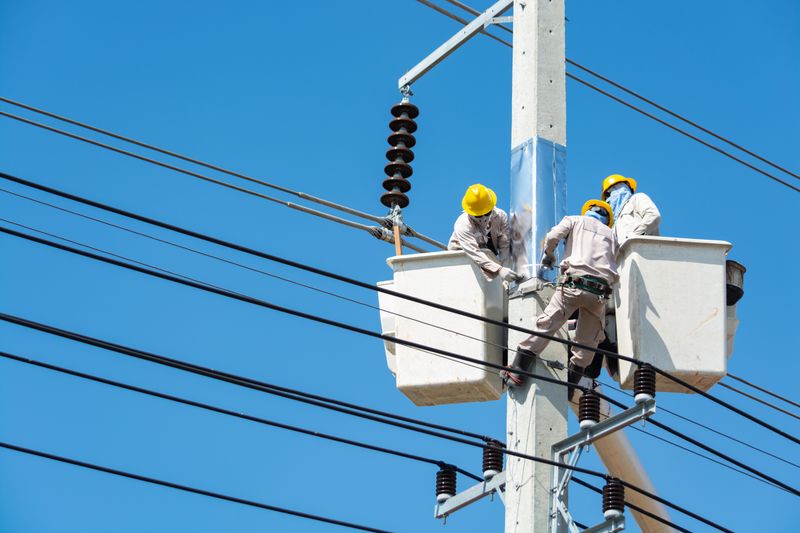
Do not touch, move, brace, cover, or closely inspect a storm-damaged service mast or weatherhead. Keep people and pets away, assume the conductors and metal parts are energized, and report the condition to the electric utility. If there is fire, arcing, smoke, or an immediate life hazard, call 911 as well.
A weatherhead is the hood-shaped fitting where service-entrance conductors emerge from a mast or raceway. Storms can bend the mast, tear its attachment from the building, lower the service drop, damage the roof flashing, or pull the meter enclosure away from the wall. The main breaker does not make the conductors on the supply side safe.
What to do right now
- Stay on the ground and keep your distance. Do not use a ladder, climb onto the roof, trim branches, or touch a wire, mast, meter box, siding, gutter, or tree near the damage.
- Report the electrical damage to the utility. Describe a “damaged service mast/weatherhead” and mention low or downed wires, a pulled attachment, roof damage, sparks, flooding, and whether the home still has power.
- Keep the area clear. Do not park, place a generator, stretch an extension cord, or let a contractor begin roof or tree work near the service conductors.
- Use normal controls only if the house is safe to enter. Turn off large appliances and sensitive electronics without approaching damaged or wet electrical equipment. Do not operate a wet, buzzing, hot, or visibly damaged panel.
- Wait for utility direction. The utility decides how its facilities are made safe and whether a disconnect, service cut, or other field action is required.
If unrelated rooms have gone dead or 240-volt equipment behaves abnormally with no branch breaker tripped, follow the partial-outage triage guide. Tell the utility about both the service damage and the affected-load pattern.
Who owns the weatherhead and service mast?
There is no national ownership rule that applies to every address. The service point and customer-versus-utility boundary come from the serving utility’s tariff and service requirements, plus local law and the specific installation.
This common overhead arrangement is only a starting point:
| Component | Often responsible | What to verify |
|---|---|---|
| Utility pole, transformer, and distribution line | Utility | Serving utility’s current service guide |
| Overhead service drop | Utility | Where utility ownership ends and attachment responsibility begins |
| Attachment hardware on the building | Customer | Utility specifications and structural repair needs |
| Weatherhead, service mast/riser, and flashing | Customer | Electrician scope, roof work, utility clearance, and permit |
| Meter | Utility | Never remove or tamper with it |
| Meter socket or enclosure | Often customer | Utility-approved equipment, electrician repair, and inspection |
| Service-entrance conductors | Varies by service point | Utility diagram and electrician confirmation |
FPL’s service-flow diagram says its meter belongs to FPL while the meter can, service mast, weatherhead, and downpipe typically belong to the property owner. Duke Energy’s Florida meter and service connection diagram shows a similar division and warns customers to avoid contact with all damaged service equipment.
Those examples are useful evidence, not permission to apply either utility’s boundary elsewhere. Ask your own utility: Which damaged parts are mine, which are yours, and what must happen before repair and reconnection?
The repair, inspection, and reconnection path
1. Utility damage assessment
Report the outage even if the outage map shows the neighborhood as restored. The Department of Energy’s storm restoration overview explains that individual homes may remain unable to receive power after larger utility repairs are complete. It also notes that damaged equipment should never be touched.
The utility checks its facilities, establishes the service boundary, and gives disconnect-reconnect instructions. A roofer, tree crew, or general handyman cannot authorize work near energized service conductors.
2. Licensed electrician inspection and scope
The electrician evaluates the customer-owned mast or raceway, weatherhead, conductors, attachment, meter socket, grounding and bonding, clearances, and damage that may continue toward the service equipment. A bent mast can also involve the roof structure or flashing, so the scope may require coordination with a qualified roofer or structural contractor after the electrical hazard is controlled.
The goal is not merely to stand the mast upright. Components, supports, conductor clearances, weather sealing, equipment ratings, and the utility’s current service standards must all be acceptable.
3. Permit and inspection
Ask the electrician which permit is required, who opens it, what the authority having jurisdiction (AHJ) will inspect, and how approval reaches the utility. Emergency-repair procedures can differ from ordinary service changes. Do not assume a same-for-same repair skips inspection.
The electrical permit and inspection guide explains how to identify the adopted code and AHJ. For a broader visible-condition record, use the home electrical inspection checklist without opening equipment.
4. Utility reconnection
Only the utility can complete its reconnection process. Requirements may include completed repairs, an inspection release, accessible approved equipment, and a scheduled crew. PG&E, for example, publishes a formal disconnect-reconnect process that specifically includes electrician work near weatherheads.
Do not reinstall a meter, reconnect conductors, remove utility seals, or energize the service yourself. A passed building inspection does not by itself authorize a homeowner or electrician to perform utility work.
Safe documentation for the handoff
From a safe ground-level location, record:
- The time and type of storm damage
- Whether the utility account shows an outage and the report number
- Whether power is fully out, partly out, or apparently still on
- Closed-view photos taken without approaching wires or damaged equipment
- Visible leaning, pulling, roof, siding, tree, or meter-enclosure damage
- Smoke, odor, sparks, buzzing, flooding, or changing light brightness
- Names or ticket numbers from the utility, electrician, insurer, and AHJ
Use the electrician handoff checklist to keep observations and questions together. If a longer outage requires backup power, review the portable generator safety guide before using equipment; never backfeed the home.
Do not mistake restored power for a cleared repair
Power can remain on even when the mast, attachment, or meter enclosure is visibly displaced. That does not make the equipment stable or safe. Keep the area isolated and report it immediately rather than waiting for the next storm or touching it to see whether it moves.
The safe sequence is straightforward: utility report, controlled de-energization when required, licensed repair, permit/inspection release, and utility reconnection. Your utility and AHJ determine the exact boundaries and order for your address.

Amperage HQ Editorial Team
Independent trade-focused editorial team