Well pump breaker keeps tripping: What to do
Quick answer
If a well pump breaker trips a second time, leave it off. An immediate trip can point to a short, ground fault, damaged cable, control fault, or locked motor; a delayed trip can involve voltage, overheating, frequent starts, or mechanical load. Trip timing is only a clue, so use it to choose an electrician, well contractor, or both—not to justify another reset.
Common questions
- Why does my well pump keep tripping the breaker?
- Possible causes include a short or ground fault, damaged circuit or drop cable, a locked pump or motor, control-box or starting-component trouble, incorrect voltage, excessive heating, or a mismatched circuit or control. The trip timing helps a qualified professional plan tests, but it does not identify the failed part by itself.
- Can I reset a well pump breaker more than once?
- No. If conditions are dry, cool, quiet, and undamaged and the equipment instructions allow it, one reset can confirm whether the trip repeats. If it trips again, leave it off. Do not reset even once when there is heat, odor, sound, damage, shock, flooding, or storm exposure.
- How can I tell a tripped breaker from a motor overload?
- A panel breaker usually leaves its handle in a tripped position and power stays off until the breaker is intentionally reset. Some motor overloads or electronic controls stop the pump while the panel breaker remains on; some can reset automatically after cooling. Do not open equipment to check—record only the visible breaker position and whether the pump restarts by itself.
- Should I call an electrician or a well contractor?
- Call an electrician first for panel, breaker, disconnect, branch-circuit, fixed-wiring, heat, odor, arcing, shock, or house-wide voltage symptoms. Call a qualified well contractor first when the pump starts or hums before the trip, stops after running, cycles too often, or the concern points to the motor, drop cable, controls, pressure system, or well. Many cases require both trades.
Source note: Reviewed November 2, 2026 against Franklin Electric's 2026 AIM manual, Pentair's current 4-inch submersible-pump instructions, ESFI electrical warning-sign guidance, and EPA private-well flood guidance. The exact pump, motor, control, and protective-device instructions govern diagnosis.
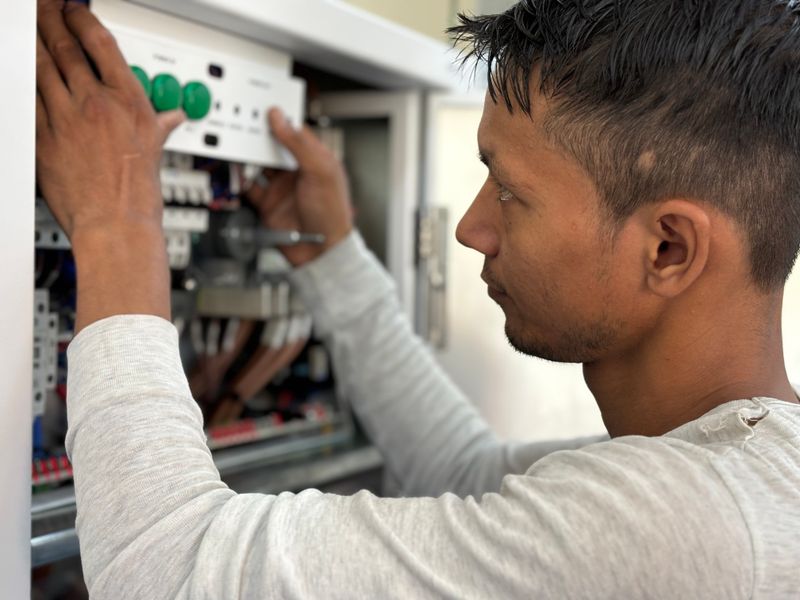
If your well pump breaker keeps tripping, stop after one permitted reset and leave the breaker off. A repeat trip can involve the branch circuit, controls, cable, motor, or pump. When it trips is useful evidence, but it is not a safe DIY diagnosis.
Do not reset even once if there is burning odor, smoke, arcing, unusual heat, buzzing or crackling, shock or tingling, visible damage, or water around electrical equipment. Keep away and use the urgent actions below.
Well pump breaker trip decision flow
Start with what you can observe without opening a panel, disconnect, pressure switch, control box, wellhead connection, or pump.
- Is there smoke, flame, active arcing, or a fire alarm? Get everyone outside, stay outside, and call 911. Do not use water on electrical equipment.
- Is equipment hot, wet, flooded, damaged, buzzing, crackling, scorched, or giving a shock? Do not touch or operate it. Call 911 for an active or worsening emergency; otherwise call an electrician urgently. Flooded well equipment also needs a qualified well professional before reuse.
- Did the breaker already trip again after one reset? Leave it off. Another reset adds no useful information and may re-energize a fault.
- Did it trip immediately, after a hum, after several minutes, or intermittently? Use the timing table below to choose the first service call.
- Did the pump stop while the panel breaker stayed on, then restart later? Treat this as a possible motor-overload or control-protection event. Stay clear because some protection resets automatically, and call a well contractor.
If the breaker will not latch after the single safe attempt, follow the stop conditions in the breaker-will-not-reset guide. Do not hold the handle on or try a different breaker.
What the trip timing can mean
| What happens | Possibilities for a professional to check | Best first call |
|---|---|---|
| Breaker trips immediately when reset or when the pressure switch calls | Short or ground fault in the circuit, controls, drop cable, splice, or motor; locked motor or pump; wiring error | Electrician when the trip is immediate or follows electrical work; well contractor for motor, cable, and pump testing |
| Pump hums or tries to start, then the breaker trips | Bound pump or motor, starting-component or control-box problem, low voltage, incorrect connection, or mismatched equipment | Well contractor; add an electrician for supply, circuit, or fixed-wiring findings |
| Pump runs for seconds or minutes, then trips | High or low voltage, heating, undersized or damaged cable, incorrect control, mechanical load, sand or obstruction, or motor trouble | Well contractor first when only the well system is affected; electrician for circuit or voltage symptoms |
| Trips intermittently after heavy water use or frequent starts | Short cycling, pressure-tank or piping problem, repeated motor heating, loose or damaged wiring, moisture, or an intermittent equipment fault | Well contractor for cycling and water-system behavior; electrician for breaker, wiring, heat, or moisture |
| Problem began after a storm, flood, excavation, pump replacement, or electrical work | Moisture, surge damage, disturbed cable, incorrect connection, or equipment mismatch | The responsible installer plus an electrician or well contractor based on what changed |
| Pump stops, breaker remains on, and water later returns | Motor thermal overload, drive, or another control may be stopping and automatically restarting the pump | Well contractor; keep clear of equipment that can restart automatically |
Pentair’s 4-inch submersible-pump instructions list different checks for protection that opens at startup versus while the motor is running. The possibilities include supply voltage, cable size, control-box match, starting components, a bound pump, and damaged motor leads. That is why timing narrows a technician’s test plan but does not prove which part failed.
Panel breaker versus motor overload
A panel circuit breaker protects the branch circuit against overcurrent and fault conditions. After it operates, its handle may sit between ON and OFF, and the well normally stays without power until someone intentionally resets the breaker.
A motor overload protects a motor from damaging heat or current. It may be inside the motor, in a control box, or provided by a drive or other controller. Some are automatic-reset devices. Franklin Electric’s 2026 AIM manual is model-specific and documents motor, control, overload, cable, and troubleshooting requirements for covered submersible systems.
The safe homeowner distinction is behavioral: did the panel handle visibly trip, or did the pump stop while the breaker remained on and later restart? Do not remove a cover, press an internal reset, or reach into controls to find out. A pump that can restart automatically is an entanglement and shock hazard even while it is silent.
Why repeated resets and a larger breaker are unsafe
Resetting repeatedly sends power back into an unresolved condition. A damaged cable, grounded motor, failed starting component, or locked pump does not become safer because it briefly runs again.
Installing a larger breaker is not a repair. Well-pump motor circuits require coordinated conductor, short-circuit and ground-fault protection, overload protection, controls, and equipment instructions. The existing breaker rating is only an observation; it is not permission to upsize. Use the well pump electrical requirements guide to understand the information a qualified installer needs.
Also do not:
- Open or adjust a pressure switch, control box, disconnect, panel, or wellhead connection.
- Perform live voltage, current, resistance, insulation, or capacitor tests.
- Discharge or replace a capacitor.
- Pull a pump or handle submerged cable or splices.
- Bypass a breaker, overload, GFCI, pressure control, drive fault, or other protection.
- Reproduce a trip by running water or forcing the pump to start.
Electrician or well contractor: who owns what?
Call a licensed electrician first when the concern involves the service panel, breaker, disconnect, building-to-well circuit, visible fixed wiring, or broader electrical symptoms. Heat, a burning smell, arcing, shock, flickering across the home, or a hot or noisy panel makes this an electrical-safety call. Use the hot-breaker guide or panel-buzzing guide for those narrower stop conditions.
Call a qualified well contractor first when the pump starts or hums before the trip, stops after running, restarts after cooling, short-cycles, loses pressure, or the likely scope includes the motor, drop cable, control box, pressure tank, underground piping, pump, or well conditions. Licensing boundaries vary, so the contractor may bring in an electrician for the supply circuit or electrical repair.
If the boundary is unclear, tell both companies that the well-pump breaker has tripped repeatedly and describe the timing. Ask who will evaluate the building circuit and who will evaluate the pump, motor, cable, controls, and hydraulic system. A coordinated visit can prevent a breaker swap from being mistaken for a diagnosis.
Prepare a safe service handoff
Record only details available from records or visible labels on closed, dry, intact equipment:
- Whether the panel breaker tripped or remained on
- Immediate, after-humming, delayed, intermittent, or auto-restart timing
- Pump, motor, drive, and control make and model
- Visible breaker description and rating
- Water-use pattern, pressure change, short cycling, or loss of water
- Storms, flooding, excavation, outages, or recent pump and electrical work
- Odor, sound, heat, flicker, shock, or damage observed from a safe distance
Put those notes in the electrician handoff checklist. The useful next step is a qualified test plan based on the exact system—not another reset.
Sources

Amperage HQ Editorial Team
Independent trade-focused editorial team