AFCI breaker keeps tripping: Fault or nuisance trip?
Quick answer
An AFCI trip can come from an actual series or parallel arc, a damaged appliance cord, a wiring or neutral fault, overload, or an interaction with a connected device. Remove plug-in loads and document when it trips, but leave fixed-wiring tests and manufacturer diagnostic codes to a qualified electrician.
Common questions
- Is every AFCI trip a nuisance trip?
- No. AFCIs are intended to respond to dangerous arcing, and repeat trips can also reveal wiring, neutral, appliance, overload, or breaker problems. Treat the trip as protective until the cause is identified.
- Can I replace an AFCI with a standard breaker?
- Do not remove required protection to stop tripping. The panel listing, circuit requirements, locally adopted code, and diagnosis determine the correct listed breaker.
Source note: Diagnostic categories checked in August 2026 against manufacturer breaker documentation. Trip indications and procedures are product-specific; use only the instructions for the exact breaker and panel.
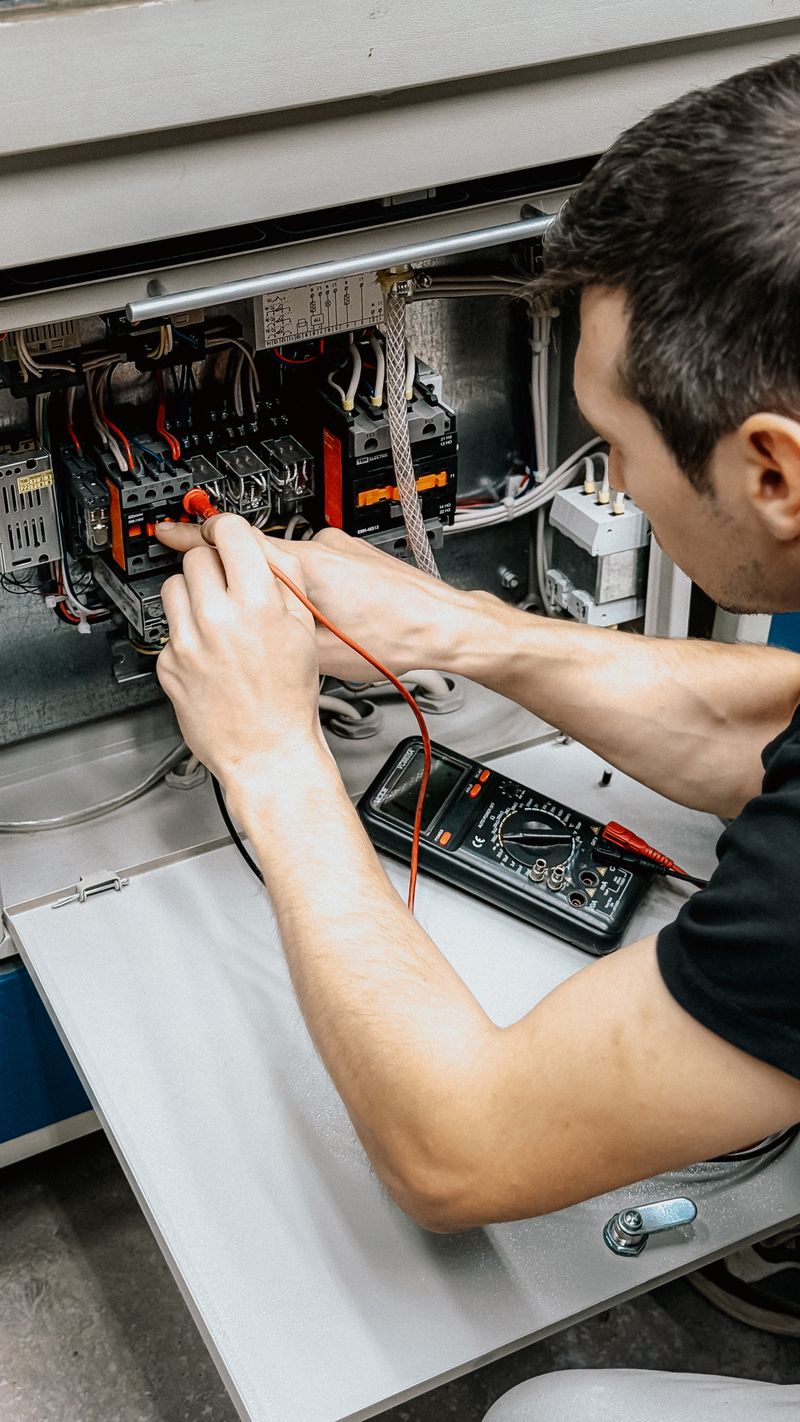
An AFCI breaker that keeps tripping should be treated as a fault report, not an annoyance to defeat. You can safely isolate plug-in equipment and record the timing. Opening boxes, moving neutrals, megger testing, or substituting breakers belongs to a qualified electrician.
Leave the breaker off immediately if you notice heat, burning odor, buzzing, crackling, smoke, water exposure, a damaged cord, or a repeat instantaneous trip. Call emergency services for smoke, flame, or active arcing.
AFCI trip versus ordinary overload
An arc-fault circuit interrupter looks for current patterns associated with dangerous series or parallel arcing. Many current products also provide ordinary overload and short-circuit protection, and some are dual-function AFCI/GFCI breakers. The handle position alone may not reveal which function operated.
Manufacturer LEDs or stored codes can help, but they are not universal. Eaton documents several product-specific trip categories, while Schneider Electric uses different Time Saver Diagnostic procedures on supported models. Read the label and exact model instructions before interpreting a light or blink count.
Our breaker type guide helps identify visible categories without opening the panel.
Safe isolation sequence
1. Record the moment of the trip
Write down what was running, what had just switched on, the room, weather, recent electrical work, and whether the breaker tripped immediately or after minutes. Note the breaker brand, model, button color, and indicator pattern only from labels visible with the panel closed.
Timing creates a useful first split:
| Trip pattern | Possibilities to investigate |
|---|---|
| Immediately when reset, even with loads off | Fixed-wiring fault, neutral problem, severe connected fault, breaker issue, or incorrect installation |
| When one appliance starts | Damaged cord/device, internal motor or switch arcing, inrush/overload, or device interaction |
| After several loads run for a while | Overload, heat-related equipment fault, loose connection, or intermittent arc |
| During rain or after water exposure | Moisture in outdoor, basement, garage, or other equipment |
| After receptacle, switch, fixture, or panel work | Loose/damaged conductor, grounded/shared neutral issue, or breaker wiring error |
These are categories, not remote diagnoses.
2. Unplug accessible loads
Turn the breaker off. Unplug every accessible cord-and-plug load on the affected circuit, including power strips, chargers, lamps, vacuum cleaners, exercise equipment, and electronics. Inspect cords and plugs without disassembling them; retire anything cut, crushed, scorched, loose, or repaired with tape.
Hardwired fixtures and hidden receptacles remain connected. If you cannot account for the full circuit, say so in the handoff.
3. Reset once, only when conditions are normal
When the panel is dry and intact and there is no heat, odor, noise, damage, or water, move the breaker fully OFF and then ON once. Do not stand in front of a damaged panel and do not remove its cover.
If it trips with all plug-in loads removed, leave it off and call an electrician. That pattern points away from a simple cord-and-plug load and toward fixed equipment, wiring, neutral, or breaker diagnosis.
4. Reconnect loads one at a time
If the breaker holds, reconnect one undamaged load at a time and allow enough time to reproduce the original pattern. Stop when the breaker trips; leave that item unplugged and the circuit off if the cause remains uncertain.
Do not confirm the theory by moving a suspect damaged appliance to a non-AFCI circuit. A second outlet can expose a different circuit to the same fault.
Genuine faults that can look “nuisance”
Repeated trips associated with one load may come from a deteriorated cord, loose plug, failing switch, motor, power supply, or internal conductor. Trips with no plug-in load can involve damaged cable, loose terminations, a nail or screw through wiring, neutral contact with ground downstream, or a shared neutral arranged incompatibly with the breaker.
Schneider Electric’s AFCI troubleshooting guidance explicitly separates arc-fault, ground-fault, and no-fault/thermal categories on supported breakers, and tells users that electrical troubleshooting should be performed by an authorized person. Its guidance is useful evidence that “AFCI tripped” is not one diagnosis.
After remodeling, ask the electrician to focus on recently moved devices, cable fasteners, splices, and neutral routing. After a storm or leak, identify wet locations. For a lighting-only symptom, our lighting circuit troubleshooting guide covers safe observations at switches and lamps.
When device interaction is plausible
Electronic power supplies, motor controls, dimmers, treadmills, vacuums, and other switching loads can create waveforms that complicate diagnosis. Manufacturers have refined detection to reduce unwanted trips. Schneider Electric’s LED troubleshooting page directs users to the model’s instruction bulletin and recorded trip indication, reinforcing that diagnostics are product-specific.
“It only trips with this device” is useful evidence, but it does not automatically prove that the breaker is defective. Check the appliance instructions, recalls, cord condition, and whether the breaker manufacturer has a technical bulletin for that exact combination. A qualified electrician can test the circuit and consult manufacturer support without removing required protection.
What not to do
- Do not swap in a standard breaker to make the trip stop.
- Do not install a different brand or family because it physically fits; the panel label and listing control compatibility.
- Do not increase breaker amperage without a full circuit design review.
- Do not separate tied handles or alter a shared-neutral circuit.
- Do not disconnect grounding or neutral conductors as an experiment.
- Do not perform another reset after heat, odor, noise, water, visible damage, or an immediate repeat trip.
The GFCI/AFCI protection guide explains why AFCI and GFCI functions are not interchangeable.
Give the electrician a reproducible pattern
Provide the breaker label and model, circuit directory description, trip timing, connected loads, recent work, weather or moisture, and any manufacturer indication. Use the electrician handoff checklist and the breaker-trip decision tool to organize observations.
The goal is not to prove “nuisance” or “real” before the visit. It is to reduce uncertainty without bypassing the protection that may be containing an arc fault.
Trace AFCI symptoms without removing protection
These related resources connect breaker identification, lighting symptoms, arc-fault purpose, and safe trip documentation.
- Circuit breaker types
Identify AFCI, GFCI, dual-function, and standard breakers from visible markings.
- GFCI and AFCI protection
Review which hazard each device detects and why the functions are not interchangeable.
- Lighting circuit troubleshooting
Document fixture and switch patterns when the trip is associated with lighting.
- Breaker-trip safety check
Capture timing, connected loads, water, heat, odor, and recent work for the electrician.

Amperage HQ Editorial Team
Independent trade-focused editorial team