Breaker hot to touch: What to do now
Quick answer
A loaded circuit breaker can feel warm, but touch alone cannot show whether it is operating within its listing or reveal the cause. Stop touching the panel. Smoke, flame, arcing, burning odor, crackling, melting, discoloration, loss of power, or rapidly increasing heat requires immediate action; warmth without those signs still deserves a closed-panel observation log and prompt review when it is new, persistent, or different from similar circuits.
Common questions
- Is it normal for a circuit breaker to feel warm?
- Some warmth can occur while a breaker carries load, and listed contact surfaces may operate above a comfortable hand temperature. Touch cannot establish compliance or safety. New, increasing, isolated, or unexplained warmth should be assessed with the load pattern and other warning signs by a licensed electrician.
- Why is one breaker hotter than the others?
- It may be carrying a larger or longer-running load, such as air conditioning, a dryer, water heater, or EV charger. A damaged connection, unsuitable component, panel problem, or failing breaker is also possible. Do not compare breakers repeatedly by touch or open the panel to diagnose the difference.
- Should I turn off a hot breaker?
- Do not approach or operate a panel that has a burning odor, buzzing, crackling, smoke, sparks, visible damage, water, or rapidly increasing heat. Move away and call 911 for fire or active arcing; otherwise call a licensed electrician urgently. When there is mild warmth only, stop the connected equipment with its normal control away from the panel if that can be done safely, then request professional guidance.
- Can I check a breaker's temperature with an infrared thermometer?
- A homeowner temperature reading does not prove compliance or identify the fault. Surface material, location, load, ambient conditions, product instructions, and measurement method all matter. Do not open a panel, defeat a cover, or reach toward energized equipment to take a reading.
Source note: Reviewed October 26, 2026 against Schneider Electric's March 2025 circuit-breaker operating-temperature bulletin, CPSC panel-access guidance, OSHA electrical-panel guidance, and U.S. Fire Administration fire-safety guidance. Product instructions and qualified measurements control; this guide does not set a universal touch or temperature limit.
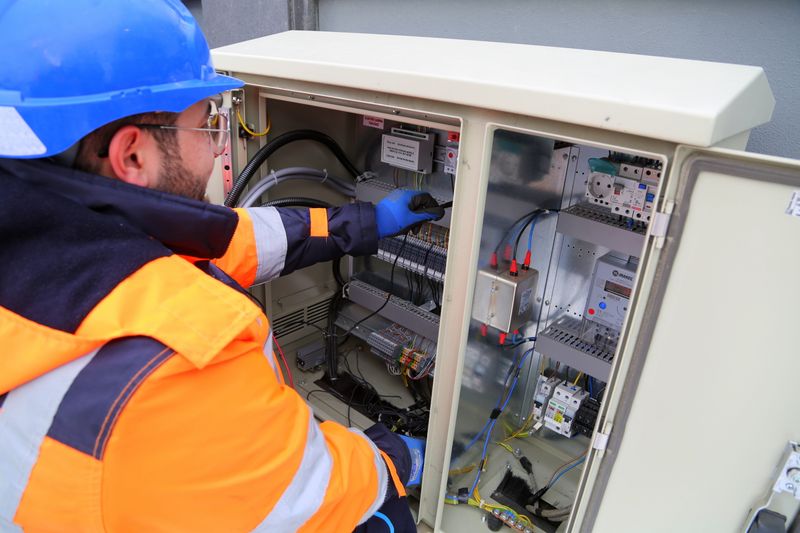
If a breaker is hot to the touch, stop touching it and check for danger from a safe distance. A breaker carrying current can feel warm, but a hand cannot determine whether the equipment complies with its listing or whether the heat comes from normal loading, a poor connection, a damaged component, or the surrounding environment.
Move away and call 911 from outside for smoke, flame, a glow, or active arcing. For burning odor, crackling, buzzing, melting, discoloration, power loss, repeated tripping, water, or rapidly increasing heat, do not operate the panel; call a licensed electrician urgently and follow utility or emergency-service instructions. If warmth is the only symptom, document the load pattern without opening or testing the panel and arrange qualified review when the change is new, persistent, or unexplained.
Hot breaker decision table
Use only observations available without touching the panel again.
| What you notice | What to do now |
|---|---|
| Smoke, flame, a visible glow, active arcing, or a fire alarm | Get everyone outside, stay outside, and call 911. Do not use water or return to operate a breaker. |
| Burning or hot-plastic odor, crackling, sizzling, loud or new buzzing, melting, or scorch marks | Keep away from the panel and call a licensed electrician for urgent service. Call 911 if the condition is active, worsening, or uncertain. |
| Heat plus a trip, failure to reset, partial outage, or repeated power loss | Leave the breaker and affected equipment alone. Do not reset it, swap it, or move the load to another circuit. |
| Panel, meter area, or floor is wet, recently flooded, or storm damaged | Do not approach or touch electrical equipment. Call the utility, electrician, or 911 as conditions require. |
| Mild warmth only while a large load is running; no odor, noise, damage, trip, flicker, or outage | Stop checking by touch. If safe, turn the appliance off at its normal control away from the panel, note whether the warmth was new, and arrange advice if it persists or returns. |
| One breaker seems much warmer than expected, even without another warning sign | Do not compare multiple breakers by hand. Record what was running and ask a licensed electrician to evaluate the circuit, breaker, connections, and panel. |
| Main breaker or broad panel area seems hot | Treat it as a panel-level concern. Do not open the cover or use the main as a diagnostic switch; request urgent qualified assessment. |
If odor is the leading symptom, use the more urgent burning-smell panel guide rather than continuing this checklist. If sound is the leading symptom, follow the electrical-panel buzzing safety guide.
Why touch cannot tell you whether a breaker is safe
Thermal-magnetic breakers create and respond to heat as current passes through them. The result depends on the breaker design, load, ambient temperature, enclosure, neighboring devices, and installation.
Schneider Electric’s March 2025 circuit breaker operating temperatures bulletin explains that listed user-contact surfaces may exceed a comfortable hand temperature. Its figures distinguish surfaces and use defined test conditions. They do not create a universal household threshold or mean every hot breaker is acceptable.
“Not painful” does not prove a connection is sound; a hot spot can exist behind the dead front while the handle feels mildly warm. Do not use your hand, a thermometer, thermal camera, or probe to declare the breaker safe, and never defeat a barrier to take a reading.
What can make a breaker feel warm or hot?
These are possibilities for the electrician to sort out, not diagnoses to make at the panel.
Current and operating time
A breaker serving a sustained load can feel warmer than one serving intermittent lights or receptacles. Air conditioners, dryers, ranges, water heaters, space heating, and EV charging have different duty cycles and circuit requirements.
Load explains context, not safety. Warmth while equipment runs does not prove the circuit is correctly sized and connected or excuse odor, discoloration, trips, or a new change.
Ambient conditions also matter. A panel in sun, a hot garage, or a mechanical room starts warmer, and adjacent loaded breakers add heat. Do not add a fan, drill ventilation holes, remove the cover, or cool the panel with water or spray.
A high-resistance or damaged connection
A loose, damaged, corroded, or incorrectly prepared connection can produce concentrated heat without an immediate trip. Finding it requires qualified inspection and controlled de-energization. Do not tighten a terminal; torque, conductor condition, and equipment instructions matter.
Breaker or panel problems
An internally damaged breaker, incompatible device, deteriorated bus connection, moisture, or recalled equipment can also be involved. Physical fit is not proof of compatibility. Do not swap positions, change brands, increase the ampere rating, or replace a breaker as a test. If replacement is recommended, the breaker replacement cost guide explains how to compare the actual scope.
Main, AC, and dryer breakers: what changes?
The response is based on warning signs, not the label alone.
Main breaker hot to touch
The main can reflect combined household load, and supply-side conductors may remain energized when its handle is off. Do not operate it repeatedly or assume OFF makes the enclosure safe. Report the load, any partial outage, and whether meter or service equipment also showed heat, odor, or noise.
If lights in different areas swing between bright and dim, 120-volt equipment behaves abnormally, or some circuits lose power while others remain on, keep clear and report a possible service problem to the utility. The loose-neutral warning guide explains that distinct pattern without asking you to test the panel.
AC breaker warm or hot
Note whether the unit was starting, running steadily, short-cycling, or stopped. Turn it off at the thermostat if safe, leave disconnects untouched, and give the technician the model, service history, and trip behavior.
Dryer breaker warm or hot
Stop the dryer with its normal control. Note the cycle, run time, recent work, and visible warning signs without touching the cord, receptacle, or panel. Leave it unused if warmth was new, strong, or accompanied by another warning sign.
Safe observations with the panel closed
The useful homeowner or facility contact task is to preserve context, not reproduce the symptom.
- Record time, duration, and change. Note when the warmth was noticed and whether it appeared to increase.
- List what was already running. Include large loads, but do not switch them on to reproduce the condition.
- Record other symptoms. From a safe location, note odor, sound, flicker, trips, partial power, damage, water, or recent work.
- Use existing labels only. Record the visible circuit description and rating outside a closed, intact panel. A closed-panel photo can help when no hazard is active, but never approach or delay an emergency call for it.
- Stop after one observation. Do not rerun the load, reset a trip, or compare handles by touch.
If the breaker has tripped or will not latch, heat ends the homeowner reset path. Leave it alone and use the breaker-will-not-reset guide only to understand the handoff—not to attempt another reset while heat or another warning sign remains.
What not to do
- Do not remove the dead front, breaker, meter cover, or service enclosure.
- Do not tighten terminals, clean contacts, or spray anything into the panel.
- Do not take live temperature, voltage, or current measurements.
- Do not swap breakers, move circuits, or install a larger breaker.
- Do not keep resetting a breaker that trips or will not latch.
- Do not run an appliance again to see whether the breaker gets hotter.
- Do not rely on a social-media temperature rule, touch-duration test, or comparison with an unrelated circuit.
The CPSC advises consumers not to open a panelboard or circuit-breaker compartment because live conductors can create an electrocution hazard. OSHA likewise treats work around exposed energized panel parts as qualified-person work. Closing the panel door does not make internal investigation a homeowner task.
Prepare the electrician handoff
Tell the electrician whether the concern is a branch, appliance, or main breaker or a broad panel area. Share the affected equipment, visible labels, timing, load pattern, recent work, outages, moisture, and warning signs.
Ask the electrician to document:
- The load and whether it matches the circuit and equipment requirements
- The exact breaker and panel compatibility
- The condition of the breaker, termination, conductor, bus, and enclosure
- Relevant manufacturer instructions and any recall check
- The cause of the heat, not only the replacement part
- Required repair, testing, permit, utility coordination, and return-to-service decision
Use the electrician handoff checklist to organize those details. A warm breaker is not automatically failed, and a breaker that still supplies power is not automatically safe; a qualified assessment connects the symptom to the actual equipment and load.
Sources

Amperage HQ Editorial Team
Independent trade-focused editorial team