How much does it cost to replace a circuit breaker?
Quick answer
Published U.S. planning ranges put a simple circuit breaker switch replacement around $100 to $600, while main-breaker work can run $500 to $2,000. The useful question is what the quote covers: diagnosis, an exact listed breaker, circuit repair, permit, utility coordination, or a larger panel project. Get the scope in writing before comparing totals.
Common questions
- How much does it cost to replace one circuit breaker?
- Published U.S. planning ranges vary from about $100 to $600 for a circuit breaker replacement. The final quote depends on diagnosis, service-call minimums, breaker type and availability, panel condition, access, permits, and local labor.
- Does a tripping breaker always need replacement?
- No. A trip can point to an overload, short circuit, ground fault, arc fault, wiring problem, damaged appliance, or another condition. The circuit should be diagnosed before a replacement is approved.
- Is replacing a main breaker the same job as replacing a branch breaker?
- No. Main-breaker work involves service equipment and may require a utility disconnect, permit, inspection, or broader panel work. It should not be priced or treated like a routine branch-breaker swap.
- Do I need a permit to replace a circuit breaker?
- Permit rules vary by jurisdiction and scope. Some places exempt a like-for-like branch breaker, while others require a permit or licensed contractor; main-breaker and service work commonly receive stricter treatment. Check with the local authority having jurisdiction before work begins.
Source note: Pricing checked September 11, 2026 against Angi's July 15, 2026 cost guide and HomeGuide's current cost guide. Technical and safety guidance was checked against Schneider Electric, ESFI, OSHA, and current local permitting examples. Published national prices are planning references, not a property-specific quote.
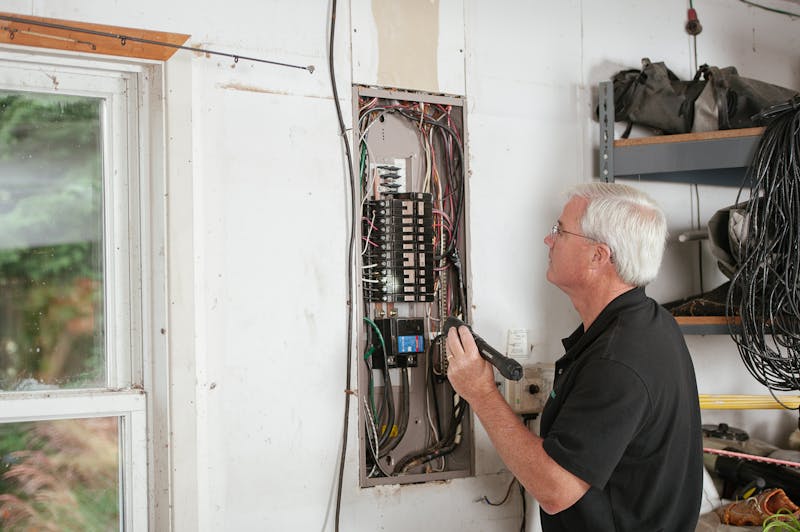
Published U.S. cost guides put a circuit breaker replacement anywhere from about $100 to $600, but that range is not one uniform job. Angi’s July 15, 2026 guide lists $100 to $200 for a circuit breaker switch replacement and $500 to $2,000 for a main breaker. HomeGuide’s cost guide, checked September 11, 2026, gives a broader $100 to $600 range for breaker replacement, including labor and materials.
These U.S. figures are planning references, not a diagnosis or bid. One quote may cover a common like-for-like branch breaker; another may include troubleshooting, specialty protection, bus damage, a permit, or utility coordination. Compare scope before price.
Do not open the panel to investigate. If there is smoke, arcing, a burning odor, water, visible damage, or unusual heat, keep away and call emergency services or the utility when appropriate, then a licensed electrician. Leave a circuit off after a repeated trip instead of cycling it again.
First ask: is the breaker actually the problem?
A tripping breaker is doing a protective job until testing shows otherwise. The cause could be an overload, short circuit, ground fault, arc fault, damaged load, loose connection, or wiring problem—not a worn breaker.
Schneider Electric’s breaker-troubleshooting guidance, last modified January 5, 2026, directs technicians to evaluate load behavior, overcurrent, connections, heat damage, and the bus before treating the breaker as suspect. This is why “replace breaker” and “diagnose circuit” are different estimate lines.
If the handle will not reset, follow the safe exterior checks in our breaker-will-not-reset guide. If an AFCI trips, preserve its indicator information and use the AFCI tripping guide. Neither symptom proves that swapping the device will solve the fault.
The five breaker quote scopes
Use this framework to identify what an electrician is actually proposing.
| Quote scope | What it should answer | Common reason the total changes |
|---|---|---|
| 1. Diagnostic visit | Which circuit, load, connection, protective function, or breaker failed? | Service minimum, test time, intermittent symptoms, and access |
| 2. One branch breaker | Is this an exact listed like-for-like device, with no circuit or bus repair? | Poles, amperage, interrupting rating, product family, and availability |
| 3. AFCI, GFCI, or dual-function breaker | Which protection is required, and will testing and trip-indicator checks be documented? | Specialty hardware, neutral configuration, fault-finding, and adopted code |
| 4. Main breaker or disconnect | Who handles the utility disconnect, permit, inspection, and outage? | Service-equipment access, part availability, utility scheduling, and panel condition |
| 5. Panel or service project | Why is a breaker-only repair unsuitable, and exactly which equipment changes? | Damaged bus, obsolete equipment, no listed replacement, capacity work, grounding/bonding, or service changes |
The last line belongs in a separate proposal. If the recommendation changes from a breaker to a panel or service upgrade, use our electrical panel upgrade cost guide to compare that larger scope.
What drives circuit breaker replacement cost?
Diagnosis and the service-call minimum
The physical swap may be only part of the visit. HomeGuide’s cost guide, checked September 11, 2026, lists a $75 to $125 diagnostic fee and notes that electricians may have a one- or two-hour minimum. Ask whether diagnosis is included in the replacement price, credited toward approved work, or billed separately.
Exact breaker type and panel compatibility
A breaker that physically fits is not automatically approved for the panel. The electrician should record the panel manufacturer and model, the label’s permitted breaker family, pole count, amperage, interrupting rating, and required protective function.
For one manufacturer-specific example, Schneider Electric states that its QO and Homeline breaker families are not interchangeable and that each fits its corresponding load center. Review our circuit breaker identification guide for the terminology, but have the contractor select the exact listed or properly classified device from the panel labeling and current manufacturer documentation.
Common breakers can be inexpensive compared with the service visit. Specialty or discontinued equipment can change both material cost and lead time. Ask for a catalog number on the quote rather than accepting “standard breaker.”
Branch breaker versus main breaker
A branch breaker protects one circuit. A main breaker is part of the service equipment and does not necessarily make its own supply-side conductors safe when switched off.
OSHA’s panel-work interpretation explains that supply-side power can remain present at an open disconnect and limits work on exposed energized parts to qualified people using appropriate practices. For a homeowner, the boundary is simple: do not remove the dead front or attempt main-breaker work. The quote should identify who arranges a complete safe disconnect and who restores service.
Panel and bus condition
Heat damage, corrosion, pitting, water exposure, or a damaged bus can turn a one-part replacement into a larger repair. Ask the electrician to document the finding and explain why the panel can or cannot safely accept a replacement.
Do not authorize a panel upgrade solely because a breaker tripped. Conversely, do not demand a breaker-only repair when the connection point or enclosure is damaged. The evidence should determine the scope.
Permits, inspection, and utility coordination
Permit rules are local. Philadelphia currently lists like-for-like circuit breaker replacement among maintenance work that may not require a permit, while New York City treats replacement of certain defective branch breakers as permitted minor electrical work by a licensed master electrician. Main service disconnects are excluded from that NYC minor-work category.
These examples, checked September 11, 2026, show why a national yes-or-no answer is unreliable. Ask the local authority having jurisdiction (AHJ) whether this exact scope needs a permit, who may perform it, and whether an inspection or utility appointment is required. Our electrical permit and inspection guide explains how to find the controlling local requirements.
Breaker quote comparison worksheet
Give every bidder the same symptom notes and ask them to complete the same fields.
| Quote item | Estimate A | Estimate B | Estimate C |
|---|---|---|---|
| Diagnostic/service-call charge and credit | |||
| Finding: breaker, circuit, load, connection, or panel | |||
| Panel manufacturer, model, and condition | |||
| Breaker catalog number, poles, amperage, and protection | |||
| Listed/classified compatibility basis | |||
| Circuit or conductor repair included | |||
| Permit and inspection responsibility | |||
| Utility disconnect/reconnect and outage plan | |||
| Functional testing and directory update | |||
| Labor, materials, cleanup, warranty, and exclusions |
If one quote says “replace breaker” and another includes fault tracing, an AFCI/GFCI device, a permit, and damaged-connection repair, their totals are not comparable yet.
Questions to ask before approving the work
- What testing supports the diagnosis? Ask what ruled out an overload, appliance fault, wiring fault, or damaged connection.
- What exact breaker is included? Get the manufacturer and catalog number, not just amperage.
- Is the replacement like-for-like? A different protection type, rating, or product family needs a documented code and compatibility basis.
- What happens if you find bus or conductor damage? Require a written change order before the scope expands.
- Does the total include the first visit? Clarify diagnostic fees, minimum labor, return trips, and material markup.
- Who handles permits and utility coordination? Put the responsible party and fees in writing.
- How will the result be tested and documented? Include the protective device’s required functional test, circuit-directory correction, and warranty.
The Electrical Safety Foundation International lists frequent breaker trips, flickering or dimming lights, warm or discolored wall plates, buzzing, burning odor, and tingling among warning signs that deserve qualified attention. Tell the electrician about the whole pattern, not only the breaker handle.
Your next step
Record when the problem began, what was running, whether the trip was immediate or delayed, which outlets or appliances lost power, and any safe-to-observe indicator code. Photograph only closed-panel labels and accessible equipment nameplates; do not remove covers.
Then use the electrician handoff checklist to request written, like-for-like estimates. The best breaker quote is not automatically the lowest total—it is the one that clearly connects the diagnosis, exact compatible part, safety controls, permit assumptions, testing, and exclusions.
Sources
- Angi: electrical panel and breaker costs, updated July 15, 2026
- HomeGuide: circuit breaker replacement cost, checked September 11, 2026
- Schneider Electric: thermal-magnetic breaker troubleshooting, modified January 5, 2026
- Schneider Electric: QO and Homeline breaker compatibility, modified April 17, 2026
- Electrical Safety Foundation International: home electrical warning signs, checked September 11, 2026
- OSHA: work inside electrical panels and supply-side exposure
- Philadelphia: electrical permit exemptions, checked September 11, 2026
- New York City: licensed electrical minor-work requirements, checked September 11, 2026

Amperage HQ Editorial Team
Independent trade-focused editorial team