Lights Flicker When the AC Turns On: What to Check
Quick answer
A slight, momentary dip that occurs only as the AC compressor starts can result from normal motor starting current. Flicker that is deep, persistent, worsening, spread across the house, or paired with breaker trips, failed starts, heat, buzzing, odor, bright-and-dim lights, or partial power needs professional diagnosis. Call HVAC for unit-specific starting problems, an electrician for wiring or panel symptoms, and the utility for widespread supply or partial-power symptoms.
Common questions
- Is it normal for lights to flicker when the AC turns on?
- A slight, very brief dip only when the compressor starts can reflect ordinary motor starting current. It should recover immediately and remain stable while the AC runs. A deep, prolonged, new, or worsening change deserves diagnosis.
- Should I call an electrician or an HVAC technician for AC-start flicker?
- Call an HVAC technician when the outdoor unit struggles, hums and clicks, starts repeatedly, cools poorly, or alone triggers the symptom. Call an electrician when multiple circuits react, other large loads cause the same change, or panel or wiring symptoms are present. Contact the utility for partial power, neighbor-wide symptoms, or widespread unstable voltage.
- Will a hard-start or soft-start kit stop the lights from flickering?
- A manufacturer-approved starting accessory may change startup current on some systems, but it is not a universal fix and cannot repair a weak connection, failing compressor, incorrect circuit, loose neutral, or utility problem. Have the cause diagnosed before adding equipment.
Source note: Reviewed in October 2026 using U.S. Department of Energy motor-start voltage-sag guidance, ESFI electrical warning signs, and Daikin model-specific installation and electrical data. No online symptom check can clear a wiring or equipment fault.
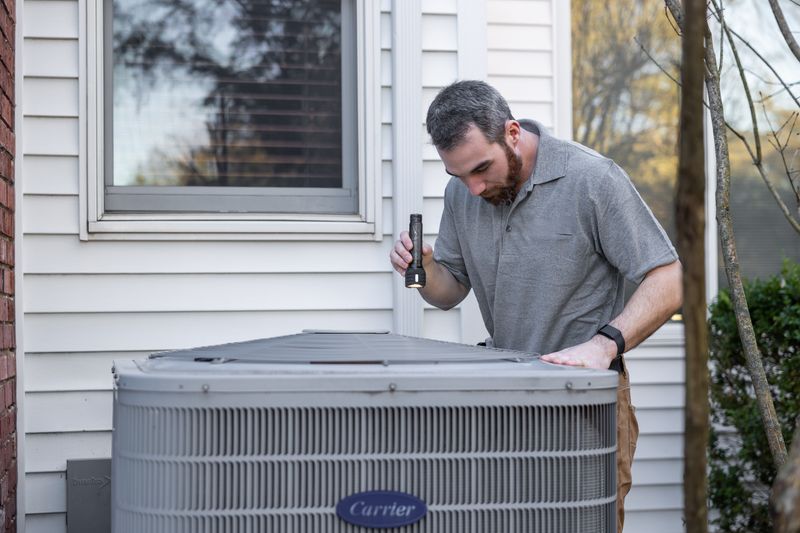
A slight, split-second dip in brightness can happen when an air conditioner compressor starts. The motor briefly draws high starting current, and the resulting voltage drop can show up in sensitive lights. The U.S. Department of Energy notes that motors with large starting currents can create voltage sags, especially when the motor is large relative to the electrical system supplying it.
That does not make every flicker harmless. If the change is new, deep, lasts beyond startup, is getting worse, or comes with other warning signs, the useful next step is not guessing at a capacitor or buying a larger breaker. It is routing the symptom to the right qualified professional.
Quick answer: normal startup dip or warning sign?
| What happens | What it may mean | What to do |
|---|---|---|
| One slight dip exactly as the compressor starts; lights recover immediately and stay steady | Motor starting current and a brief voltage sag may be involved | Note the pattern and watch for change; mention it at routine HVAC service if concerned |
| The dip is deeper, lasts longer, or has become more noticeable | The unit may be starting harder, or the circuit, connection, service, or supply may have excessive voltage drop | Schedule diagnosis rather than waiting for a failure |
| Lights pulse or flicker while the AC continues running | This is not just a one-time startup event | Turn cooling off at the thermostat and call an HVAC technician or electrician based on the routing guide below |
| The outdoor unit hums, clicks, stops, or repeatedly tries to start | Compressor, contactor, control, capacitor, supply, or another equipment problem is possible | Leave the system off and call a qualified HVAC technician |
| A breaker trips when the AC starts | An overload, short circuit, ground fault, equipment fault, or circuit problem may exist | Leave the system off; do not reset the breaker repeatedly; arrange HVAC and electrical diagnosis |
| Unrelated rooms brighten and dim, or the whole house behaves erratically | A service or neutral problem may be involved | Treat it as urgent; use the loose-neutral warning guide and contact the utility and an electrician |
| Some rooms lose power or 240-volt equipment stops working | A lost service leg or another partial-power fault is possible | Follow the partial-power outage triage guide and call the utility promptly |
Do not use an exact number of seconds or a guessed voltage percentage as an all-clear. Light technology, compressor design, circuit length, service impedance, and utility conditions all affect what you see. Change, severity, scope, and accompanying symptoms are more useful homeowner observations.
Stop using the AC for these warning signs
Use the thermostat to turn cooling off if it is safe to do so. Do not approach or touch a panel, disconnect, receptacle, or outdoor unit that is hot, buzzing, wet, damaged, smoking, or giving off a burning odor.
Get urgent help for:
- Smoke, flame, active arcing, or a strong burning smell
- Heat, discoloration, crackling, or loud buzzing at electrical equipment
- Repeated breaker trips or a breaker that will not stay reset
- A compressor that hums, clicks off, or attempts to restart repeatedly
- Lights that become unusually bright in one area while dimming elsewhere
- Shocks or tingling from appliances, plumbing, switches, or equipment cases
- Partial power, failed 240-volt loads, a damaged service line, or similar symptoms at neighboring homes
Call 911 for fire, active arcing, or an immediate life-safety hazard. Keep well away from damaged service conductors and contact the utility’s emergency line. ESFI includes flickering or dimming lights, burning odors, discolored switches, and warm outlets among signs of a potentially serious wiring problem.
Why the AC can cause a brief light dip
A traditional single-stage compressor motor needs more current while accelerating than after it is running. That temporary demand produces a voltage drop across the impedance of the utility supply, service, panel, and circuit conductors. Lights can make the change visible even though they are not on the dedicated AC branch circuit.
The size of that starting event is equipment-specific. Daikin’s DX5SE data, for example, lists separate rated-load amps (RLA) and locked-rotor amps (LRA) for each exact model. Those values vary across the product family, which is why a technician uses the outdoor unit’s nameplate and model-specific documentation rather than a generic “three-ton AC” rule.
The separate appliance-start dimming guide explains the wider branch-circuit and service-load picture. This guide stays focused on what the AC itself adds to the decision.
Who should you call first?
Call an HVAC technician when the symptom follows the AC
Start with HVAC service when the outdoor unit starts slowly, hums or clicks, cycles off quickly, cools poorly, or began acting differently after equipment work. A qualified technician can compare the exact model and nameplate with its manual, evaluate controlled startup behavior, and inspect the contactor, capacitor, compressor, controls, and other approved components.
Capacitors can retain hazardous energy. Do not open the outdoor disconnect or unit, test a capacitor, touch terminals, or bypass a safety device. Daikin’s installation instructions reserve service for trained personnel, warn of multiple power sources, and explicitly say not to bypass safety devices.
Call an electrician when the symptom extends beyond the AC
Start with a licensed electrician when lights across multiple circuits react, other large loads create the same symptom, or there is buzzing, heat, odor, discoloration, or known electrical work. The electrician can evaluate connections, conductor sizing and condition, voltage drop, the panel, the AC branch circuit, service equipment, and calculated load.
An empty breaker space does not prove the service can support equipment. Use the panel and load-calculation guide for that distinction. If the AC circuit itself is in question, the dedicated-circuit cost guide explains what belongs in a quote without implying that a new circuit is automatically the cure.
Call the utility for supply-side or partial-power symptoms
Report the problem to the utility when the entire home is affected, neighbors see the same dip, lights become unusually bright and dim across unrelated rooms, or part of the home loses power. The utility can investigate voltage and equipment on the supply side it owns; an electrician handles customer-owned service and wiring. Contact both when the boundary is unclear or voltage remains unstable.
What to record before the service call
Do not cycle the AC repeatedly to reproduce the problem. During normal operation, record:
- Whether the change occurs when the indoor fan starts or when the outdoor compressor starts
- One light, one room, several circuits, or the whole house
- A single dip at startup versus continuing flicker while the system runs
- Whether the symptom is new, seasonal, or worsening
- Outdoor-unit humming, clicking, repeated starts, weak cooling, or shutdown
- Breaker trips, odors, heat, buzzing, storms, outages, or recent HVAC/electrical work
- The outdoor unit’s visible make and model, without removing a cover
- A short video from a safe location, if it does not delay an urgent call
Put the notes in the electrician handoff checklist. If a heat pump or mini-split is being installed or replaced, use the model-specific electrical requirements guide before anyone assumes an existing circuit is suitable.
Do not jump straight to a start kit or panel upgrade
A compatible soft-start or hard-start accessory can alter starting behavior on certain equipment, but the exact system, manufacturer instructions, listing, compressor condition, and reason for the voltage drop matter. An accessory should not be used to mask a failing compressor, poor connection, incorrect conductor, unstable neutral, or utility problem.
Likewise, a larger service or panel is not the automatic answer. Diagnosis may point instead to HVAC service, a branch-circuit correction, a service connection, lighting compatibility, or utility equipment. Measure and identify the cause first; scope the repair second.
Next step
If the flicker is slight, momentary, start-only, and unchanged, document it and watch for change. If it is new, worsening, persistent, widespread, or paired with failed starts, trips, heat, noise, odor, bright-and-dim behavior, or partial power, turn the AC off safely and arrange professional help now.
Sources
- U.S. Department of Energy: Improving Motor and Drive System Performance, motor starting current and voltage-sag guidance, accessed October 5, 2026
- Electrical Safety Foundation International: Electrical Warning Signs, accessed October 5, 2026
- Daikin DX5SE installation instructions, IOD-4036D, accessed October 5, 2026
- Daikin DX5SE model-specific electrical data, SS-DX5SE, accessed October 5, 2026
- PG&E: Report a voltage problem, accessed October 5, 2026

Amperage HQ Editorial Team
Independent trade-focused editorial team