Outlet not working but breaker not tripped: What to check
Quick answer
When an outlet is not working but no breaker looks tripped, first rule out the plug-in device and a wall switch, then check for one breaker handle in the middle position and an upstream GFCI. If those visible checks do not restore power, the receptacle or a hidden connection may have failed and needs a licensed electrician.
How to check a dead outlet without opening it
Use visible, homeowner-safe checks to narrow down why an outlet has no power while keeping the receptacle, panel, and wiring closed.
1. Stop for warning signs
Do not touch or test an outlet that is hot, scorched, wet, buzzing, arcing, loose, or giving off a burning odor. Keep people away and call a licensed electrician.
2. Rule out the plug-in device
Unplug the device and confirm it works at a different known-working outlet. Check both halves of the original receptacle only when it is dry, intact, cool, and quiet.
3. Map the affected area
Check nearby lights and receptacles without removing any covers. One dead outlet, a connected group, and unrelated rooms losing power point to different fault categories.
4. Check visible switches and the breaker once
Operate likely wall switches, then look at the labeled breaker from outside a safe, closed panel. A clearly tripped handle may be moved fully OFF and then ON once.
5. Check accessible upstream GFCIs
Look in kitchens, bathrooms, garages, basements, laundry areas, and outdoors. Reset a dry, undamaged GFCI once according to its instructions.
6. Escalate unresolved or recurring faults
If power does not return or fails again, stop. A qualified electrician can isolate a failed receptacle, open neutral, loose connection, fixed-wiring fault, or wider supply problem.
Common questions
- Why would an outlet stop working if the breaker did not trip?
- The connected device may have failed, the receptacle may be switch-controlled, an upstream GFCI may have tripped, or the breaker handle may be in a subtle middle position. A failed receptacle or loose circuit connection is also possible.
- Can one GFCI control outlets in another room?
- Yes. One GFCI can protect downstream receptacles, including outlets in a garage, bathroom, basement, kitchen, laundry area, or outdoors. The reset device may not be in the same room as the dead outlet.
- When does a dead outlet require an electrician?
- Call an electrician if visible controls do not restore power, the problem returns, several outlets fail, or there is heat, discoloration, buzzing, arcing, burning odor, water exposure, looseness, or abnormal voltage behavior.
Source note: Homeowner-safe checks reviewed in August 2026 against CPSC electrical-outlet guidance, ESFI warning signs, and Eaton breaker operating guidance. Product instructions and local electrical rules control.
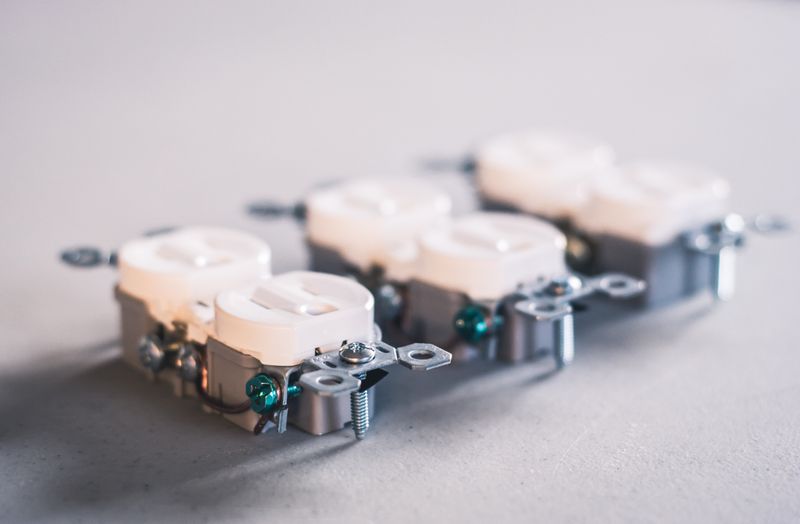
If an outlet is not working but the breaker does not look tripped, check the appliance, wall switches, one hidden breaker trip, and upstream GFCIs. Keep every cover closed. If those visible checks do not restore power, stop: a failed receptacle, loose connection, or open neutral requires qualified testing.
Do not start by removing the outlet or probing its slots. A dead receptacle is not proof that the wiring behind it is de-energized.
Stop immediately for these warning signs
Do not touch the outlet, plug, switch, or panel when you notice:
- Heat, scorch marks, discoloration, melting, or a burning odor
- Arcing, sparks, buzzing, crackling, or sizzling
- Water exposure, a wet floor or wall, or recent flooding
- A loose, cracked, or broken receptacle
- A shock, tingle, or abnormal voltage symptom
- Lights becoming unusually bright and dim or equipment behaving erratically
Keep people away and call emergency services for smoke, flame, or active arcing. Otherwise, leave the affected outlet unused and contact a licensed electrician. ESFI identifies warm or discolored outlets, buzzing, and burning smells as signs of a wiring problem that needs qualified inspection in its home electrical safety guidance.
Dead outlet diagnostic table
| What you observe | Most likely category | Safe next action |
|---|---|---|
| One device does not work, but another small device works in the same outlet | Failed appliance, cord, charger, or power strip | Stop using the failed item; inspect its plug and cord without opening it |
| One half of a duplex outlet is dead | Wall-switched receptacle or failed contact | Try nearby wall switches; if the pattern changed unexpectedly, call an electrician |
| One outlet or a connected group is dead | Upstream GFCI, subtle breaker trip, failed receptacle, or open connection | Check visible controls once, then arrange diagnosis if power stays off |
| Bathroom, garage, kitchen, basement, laundry, or outside outlet is dead | Upstream GFCI or moisture-related trip | Find the protecting GFCI; reset only when everything is dry and undamaged |
| Breaker handle is centered or slightly out of line | Breaker tripped even though it did not move fully to OFF | Unplug accessible loads, move it fully OFF and then ON once |
| Several unrelated rooms or 240-volt appliances are affected | Service leg, main connection, or wider supply fault | Report a partial outage to the utility; do not open the panel |
| Lights flicker or swing bright and dim near the dead outlet | Loose/open neutral or service fault | Turn off loads with normal controls and seek urgent qualified help |
The location alone does not identify the cause. An outside outlet, for example, may be protected by a GFCI inside the garage, while a bedroom receptacle may be intentionally controlled by a wall switch.
A safe six-step check
1. Rule out the device first
Unplug the lamp, charger, appliance, power strip, or extension cord that appeared to lose power. Confirm that item at a different known-working outlet only when the item and both locations are dry, cool, intact, and free of odor or noise.
Then plug a known-working small lamp into each half of the original receptacle. Do not use a heater or other high-load appliance as a test. If the plug fits loosely, stop using the receptacle even if power returns.
2. Map what else is dead
Check nearby receptacles, lights, and ordinary wall controls without opening any covers. Write down whether the symptom affects:
- One plug-in device
- One half of one receptacle
- One entire receptacle
- Several outlets in a line or one room
- Unrelated rooms or major appliances
This map matters. One dead location is more consistent with a local device or upstream branch-circuit issue. If unrelated areas have lost power, use the urgent half-the-house power-loss guide instead of continuing outlet-by-outlet checks.
3. Try likely wall switches
Operate nearby wall switches one at a time. Bedrooms, living rooms, garages, patios, and some older homes may have a fully or partially switched receptacle intended for a lamp.
If a switch used to control the outlet but no longer does, or the outlet became intermittent when the switch was moved, stop. The switch, receptacle, or a connection may have failed; toggling it repeatedly is not a repair.
4. Look for a hidden or half-tripped breaker
From outside a dry, intact, cool, and quiet closed panel, compare the handles. A tripped breaker can rest between ON and OFF and look nearly aligned. Eaton’s breaker fundamentals describes this intermediate trip position.
If the circuit is clearly identified and there are no warning signs, unplug accessible loads and move that breaker fully to OFF, then back to ON one time. Do not remove the panel cover, use abnormal force, reset every breaker, or keep retrying. If the handle will not latch or power fails again, follow the breaker-will-not-reset safety path and leave it off.
5. Find an upstream GFCI
One GFCI can remove power from ordinary-looking receptacles downstream. Check accessible devices in bathrooms, kitchens, garages, basements, crawl-space entrances, laundry areas, utility rooms, and outdoors. The GFCI may be farther away than expected or on the other side of a shared wall.
Reset a GFCI only when it and the surrounding area are dry, intact, cool, and free of odor or sound. Press RESET once according to the exact device instructions. If it will not latch or trips again, do not bypass it or substitute a standard outlet; use the focused GFCI-will-not-reset guide.
The CPSC recommends verifying that a GFCI’s TEST button actually removes power and that RESET restores it, rather than relying only on a click. Its home safety checklist also says unusually warm outlets should be taken out of use and checked by an electrician.
6. Stop when visible controls do not solve it
If the appliance, switches, breaker, and accessible GFCIs do not explain the outage, the remaining causes are behind a cover or require electrical measurements. That is the boundary for a licensed electrician.
Do not use a screwdriver, multimeter probe, jumper, non-contact tester, or plug-in tester to justify opening the receptacle. An all-dark plug-in tester can mean an open hot, upstream trip, failed device, poor contact, or a tool limitation; the outlet-tester guide explains why it cannot prove a circuit is safe to touch.
What may have failed behind the wall
Failed receptacle
Internal contacts can wear out, and a connection at the receptacle can fail. Clues include a plug that no longer grips, intermittent power, or downstream outlets failing at the same time. Replacement alone is not a complete diagnosis when heat or damaged wiring may extend into the box.
Loose or open connection
Receptacles on a branch circuit can feed other locations. A loose splice or terminal at one device may interrupt power downstream without drawing enough current to trip the breaker. High-resistance connections can also overheat, so do not keep moving plugs or pressing on the face to make power return.
Loose or open neutral
An open neutral can make a receptacle appear dead while energized conductors remain present. On some circuits, neutral trouble can also cause flicker, unstable equipment behavior, or damaging voltage imbalance. This is not a homeowner meter test; keep loads off and request urgent qualified diagnosis when brightness or voltage seems abnormal.
Wider circuit or service fault
When multiple unrelated circuits fail, 240-volt equipment stops working normally, or lights swing between bright and dim, the fault may be at the service rather than the receptacle. Contact the utility about a partial outage first, then an electrician if the utility confirms its side is normal.
What to do next
If power returned after one switch, breaker, or GFCI action, record what changed and reconnect only dry, undamaged loads one at a time. Stop at any repeat failure. A restored outlet has not ruled out an intermittent connection.
If power did not return, mark the receptacle out of service and use the electrician handoff checklist to record the affected locations, breaker label, GFCI locations, recent work, weather or water exposure, connected loads, and visible symptoms. That information helps the electrician distinguish a failed receptacle from an upstream open connection without repeating unsafe experiments.
The practical limit is simple: check visible controls once, but do not open, bypass, or live-test the circuit. Heat, scorch marks, arcing, buzzing, burning odor, water, abnormal voltage, or a recurring outage all move the job directly to a licensed electrician.
Continue the dead-outlet diagnostic path
Use these resources to separate a local receptacle problem from a protective-device trip or a wider supply fault.
- GFCI will not reset
Follow the focused safety path when an upstream GFCI will not latch or trips again.
- Breaker will not reset
Know when one reset attempt ends and qualified diagnosis begins.
- Half the house has no power
Escalate scattered circuit loss, failed 240-volt loads, or unstable voltage as a possible service fault.
- Electrician handoff checklist
Record the outlet map, visible controls, connected loads, and safety symptoms for the service call.

Amperage HQ Editorial Team
Independent trade-focused editorial team